Stablecoins and Payments
USDC vs USDT for Business Payments
How USDC and USDT compare for businesses accepting stablecoin payments, covering availability by network, customer preference, transparency and practical risks.
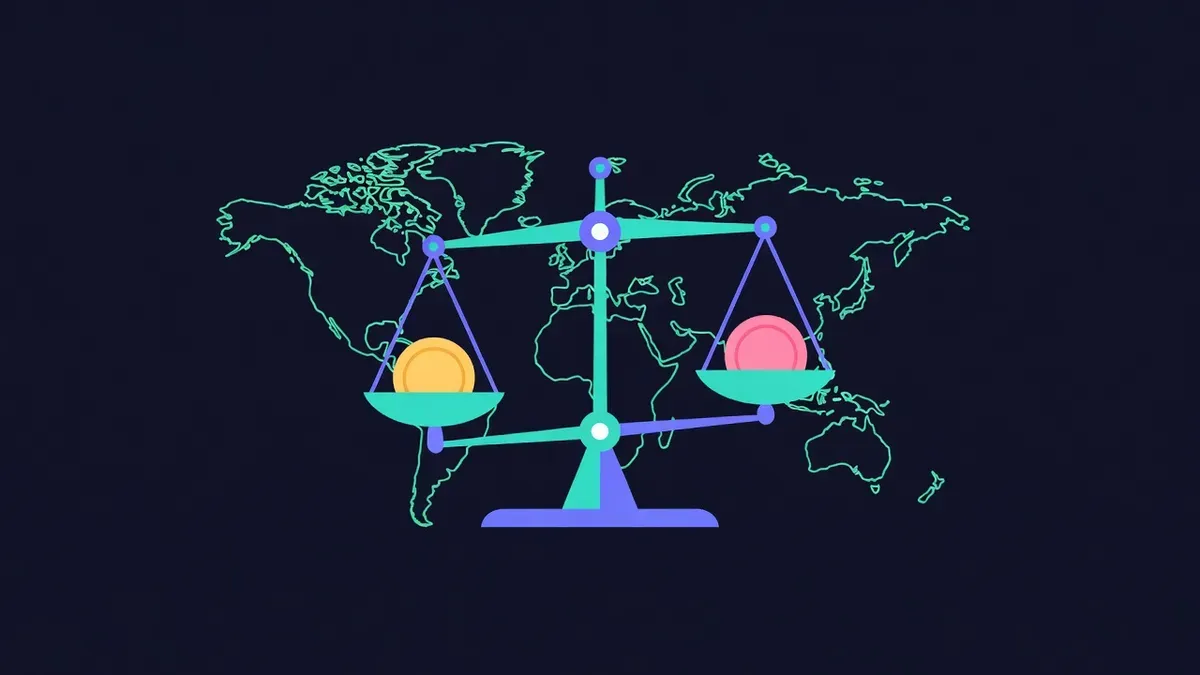
If you accept stablecoin payments, you will quickly face a practical question: USDC, USDT or both? The two largest dollar stablecoins look similar from a customer's point of view. Each is meant to be worth one US dollar and each moves across many blockchains. The differences show up in where customers hold them, how issuers report reserves and which networks support each one.
What they have in common
Both USDC and USDT are issued by companies that say they hold reserves backing each token. Both can be sent peer to peer on multiple blockchains, and both are widely supported by wallets and exchanges. For a business, either one lets customers pay in dollars from anywhere with an internet connection.
Both issuers can also freeze tokens at specific addresses. That capability exists to respond to theft and legal orders, and it is a reminder that stablecoins are not the same as holding cash in your own safe.
Where customers hold them
Customer preference often decides the question. USDT has historically been very popular on exchanges and in regions where people use stablecoins for savings and remittances. USDC is common in DeFi applications and with customers who use regulated exchanges and fintech apps in some markets.
If you sell to a global audience, you will find customers who hold only one of the two. Accepting both removes a reason for someone to abandon checkout.
Availability by network
Not every stablecoin exists natively on every network. Before choosing, check which versions are available on the chains you plan to support. Some tokens on some chains are bridged versions rather than native issuance, which adds another layer of risk.
| Consideration | Why it matters for payments |
|---|---|
| Native issuance on your network | Fewer bridge risks and wider exchange support |
| Decimals used by the contract | Affects how you calculate amounts in code |
| Exchange deposit and withdrawal support | Customers can pay directly from exchange balances |
| Liquidity for conversion | Easier to swap if you need the other stablecoin |
Decimals deserve special attention if you build your own checkout. Some stablecoin contracts use six decimals, while others on certain networks use eighteen. Reading the value from the contract rather than assuming prevents costly mistakes.
Transparency and reserves
Issuers publish reports about their reserves, and the level of detail and the type of reports differ. Businesses that hold stablecoins for weeks or months often read those reports and follow news about each issuer. If your business converts to another currency quickly after payment, issuer differences matter less day to day.
This is not investment advice. The point is to understand that the two tokens depend on different companies and different reserve arrangements.
Practical risks for merchants
Several risks apply to both tokens:
- Depeg events. A stablecoin can briefly trade below one dollar during market stress.
- Freezes. Funds at an address linked to theft can be frozen by the issuer.
- Wrong network payments. Customers may send the right token on the wrong chain.
- Contract mistakes. Accepting a fake token with the same name but a different contract.
Always verify the token contract address as well as the name when detecting payments. Scam tokens with familiar tickers are common.
A sensible default
For most small businesses selling online to a crypto audience, accepting both USDC and USDT on a few low-fee networks is a good default. It covers the majority of customers, keeps fees low and gives you flexibility. Keep separate records of which token each payment used, and decide on a policy for converting or holding balances.
That is the approach Proud Globe takes: tiles and sponsorships can be paid in USDC or USDT on Base, Arbitrum, Polygon, BNB Chain, Optimism or Ethereum, with each token contract checked on-chain.
Educational content only. Nothing here is financial, legal or tax advice. Crypto assets carry risk, so check the details for your own situation.