Token Launches
Tokenomics Tables Explained for Non-Economists
How to read and build a tokenomics table, covering supply, allocations, vesting, unlock schedules and circulating supply, with the warning signs worth checking.
A tokenomics table looks simple: a list of groups and percentages that add up to one hundred. The details hidden in that table decide how much supply can reach the market, when, and in whose hands. Anyone can learn to read one well by knowing which columns matter and which questions to ask.
The basic parts of a tokenomics table
Most tables include some version of these columns:
- Allocation group, such as team, investors, community, treasury, liquidity or ecosystem fund
- Percentage of total supply for each group
- Token amount, which is the percentage applied to total supply
- Cliff, the period before any tokens unlock
- Vesting period, how long it takes for the rest to unlock after the cliff
- Unlock at launch, the share available immediately
A complete example might look like this:
| Group | Share | Unlock at launch | Cliff | Vesting after cliff |
|---|---|---|---|---|
| Community rewards | 35% | 5% of group | None | 48 months linear |
| Treasury | 20% | 0% | 6 months | 36 months linear |
| Team | 18% | 0% | 12 months | 36 months linear |
| Investors | 15% | 0% | 12 months | 24 months linear |
| Liquidity | 7% | 100% | None | None |
| Airdrop | 5% | 100% | None | None |
Total supply and circulating supply
Total supply is every token that will ever exist under current rules. Circulating supply is the amount that can move freely today. The gap between them matters because tokens that unlock later can be sold later.
Market cap based on circulating supply can look small while fully diluted value, based on total supply, looks large. Both numbers are useful. Neither tells the full story alone.
Cliffs and vesting
A cliff delays unlocking. After the cliff, vesting releases tokens gradually, often every day, week or month. Linear vesting spreads unlocks evenly. Some schedules release a large chunk at the end of the cliff and then vest the rest.
Longer cliffs and vesting periods for the team and investors signal that insiders expect to stay involved. Very short schedules suggest they might not.
Unlock calendars
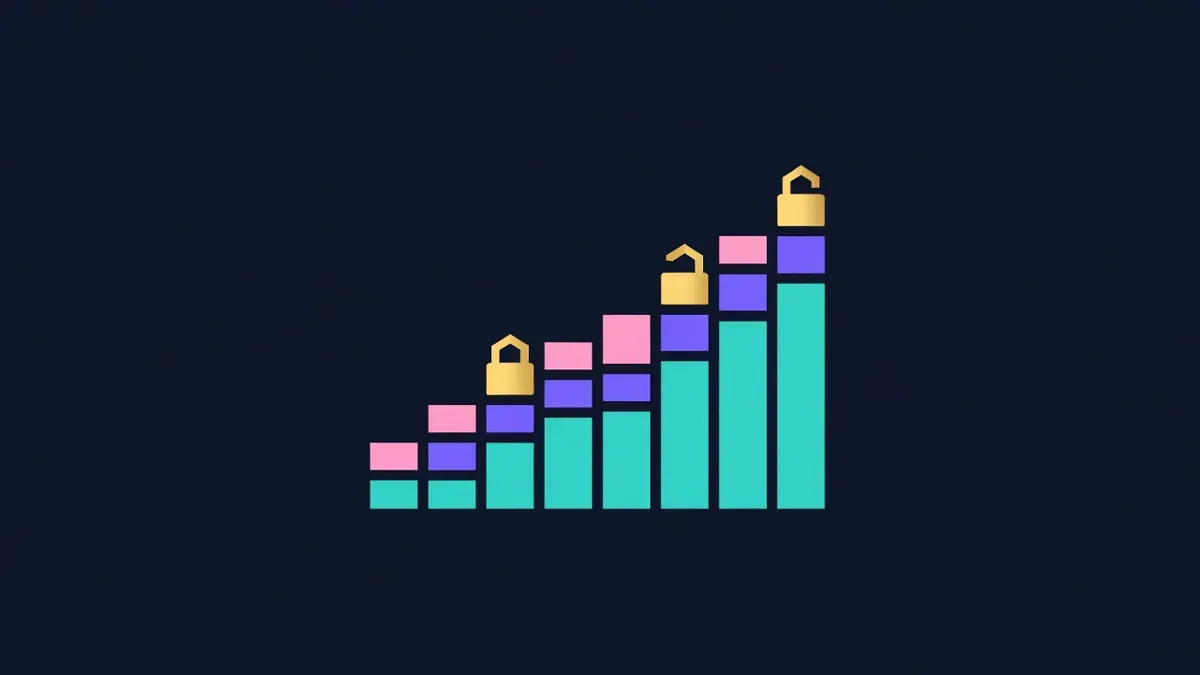
A tokenomics table becomes much more useful when you turn it into a calendar. For each month after launch, add up how many tokens unlock across all groups. Large months stand out immediately.
Check whether big unlocks cluster in the same month. A month where team, investors and treasury all unlock together can bring a lot of new supply at once, and markets often react ahead of time.
Warning signs worth checking
A few patterns deserve a closer look:
- Allocations that do not add up to exactly one hundred percent
- Large "ecosystem" or "marketing" groups with no rules for how they are spent
- Team and investor tokens unlocking at launch
- A treasury controlled by one wallet instead of a multisig
- Contracts that allow new tokens to be minted without clear limits
- Numbers on the website that differ from numbers in the docs
None of these proves bad intent, but each one is a reasonable question for the team.
Verify on-chain
Tables are claims. Contracts are facts. Look up the token contract on a block explorer and check total supply. Look at the largest holder addresses and see whether they match the allocation groups. Vesting contracts are often public too, and you can confirm the schedule matches what the team published.
If you are building one
Publish the table, the unlock calendar and the vesting contract addresses together. Explain each group in a sentence. Keep one version of the numbers and update every page when anything changes. Clear tokenomics will not make a weak project succeed, but unclear tokenomics can sink a good one.
New holders often look for a project in several places before buying. Keeping your official links consistent across your site, docs and listings, including a Proud Globe pin, makes it easier for them to confirm they are reading the real numbers.
Educational content only. Nothing here is financial, legal or tax advice. Crypto assets carry risk, so check the details for your own situation.